
I have been on MasterClass for over a year now. I have finished more than a dozen classes end to end, started and partially watched several more, and recommended specific courses to enough people in my audience that I now have a pretty clear sense of what actually delivers and what looks good in the trailer but loses steam by lesson five.
I am coming at this from an affiliate marketing and content creation background. So my lens for evaluating these courses is a bit different from someone who just wants to learn to cook or pick up tennis. I am asking: does this class make me think better, write better, pitch better, build better? But I have also branched out into courses that have nothing to do with my work, because one of the genuine pleasures of MasterClass is that you can spend a Sunday afternoon inside Gordon Ramsay’s kitchen or follow Neil Gaiman through the mechanics of how he builds a story. That breadth is part of what makes the platform worth it.
I am also going to tell you about a major new development at MasterClass that most reviews are not covering yet. More on that at the end. Let me get into the courses.
Content Outline
A Quick Note on How MasterClass Works
Before I get into the rankings, a quick orientation for anyone new to the platform. MasterClass charges $10 per month on the Standard plan, billed annually at $120 per year. The Plus plan runs $15 per month at $180 per year and adds offline access and two-device streaming. The Premium plan is $20 per month at $240 per year for six devices and six profiles.
Every class follows roughly the same format. Around 20 video lessons, each about 10 minutes long. Total runtime is typically two to three hours. Each class includes a PDF workbook. There is an audio-only mode that I use constantly. All plans come with a 30-day satisfaction guarantee and a 14-day Guest Pass you can send to someone else.
Now onto the courses.
1. Chris Voss Teaches the Art of Negotiation
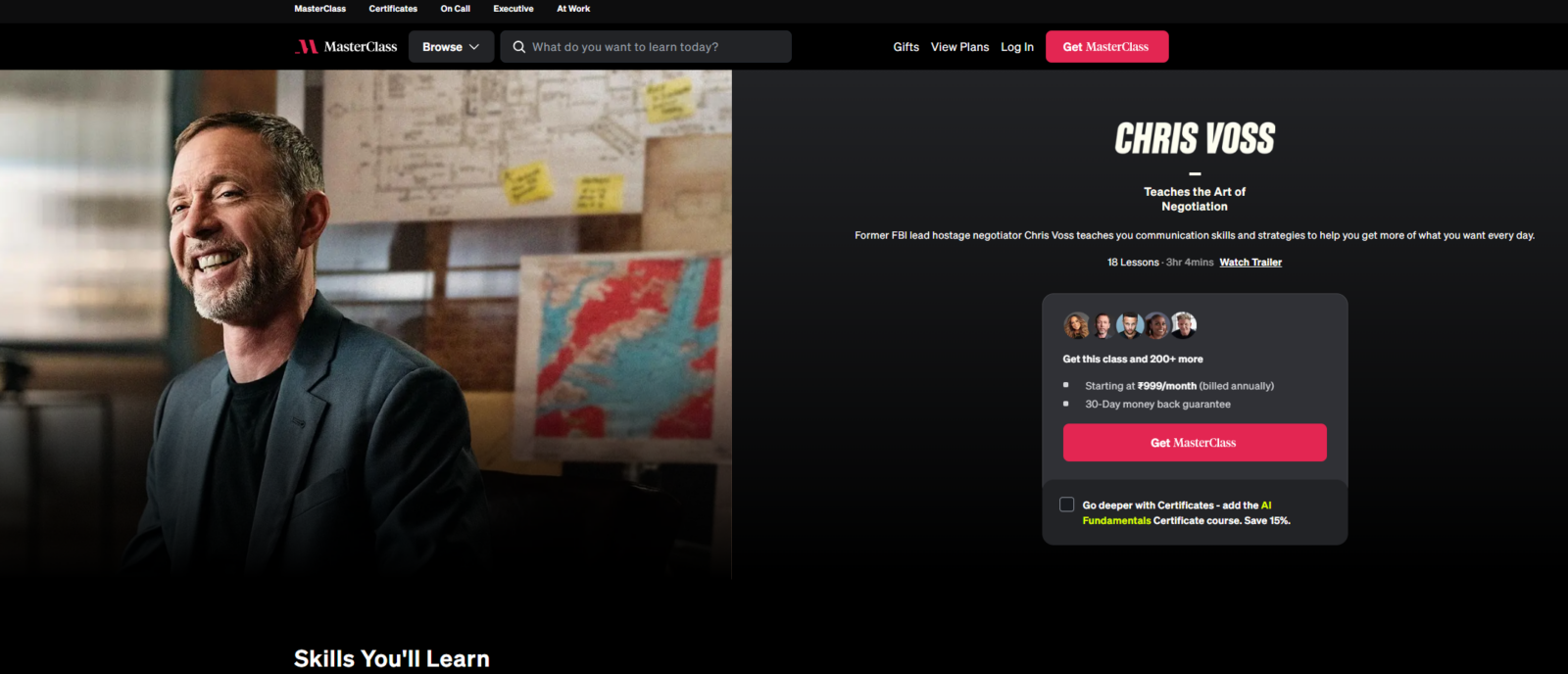
This is the class I point to most often when someone asks me whether MasterClass is worth the money. Chris Voss is a former FBI lead international hostage negotiator. He wrote Never Split the Difference, which is widely considered one of the most useful books on negotiation ever written. His MasterClass is built around the same frameworks from that book, but watching him demonstrate the techniques in video format hits completely differently from reading about them on the page.
The class covers tactical empathy, mirroring, labelling emotions, the power of the word No, calibrated questions, and how to use silence as a negotiation tool. Voss is a natural teacher. He is warm, funny, and deeply practical. He role-plays scenarios with his son Brandon throughout the class, which makes abstract concepts tangible in a way that few instructors manage to pull off.
From my perspective as an affiliate marketer, this class is directly applicable to three things I do regularly: negotiating commission rates with affiliate program managers, pitching brands for sponsorships, and structuring email outreach in a way that gets responses. I have used the mirroring and labelling techniques in real conversations since watching this class. That is a rare thing to be able to say about an online course.
The workbook for this class is among the best on the entire platform. It summarises every technique clearly enough that you can come back and use it as a reference without rewatching the video.
Who it is for: Anyone who negotiates anything. That means everyone.
2. Malcolm Gladwell Teaches Writing
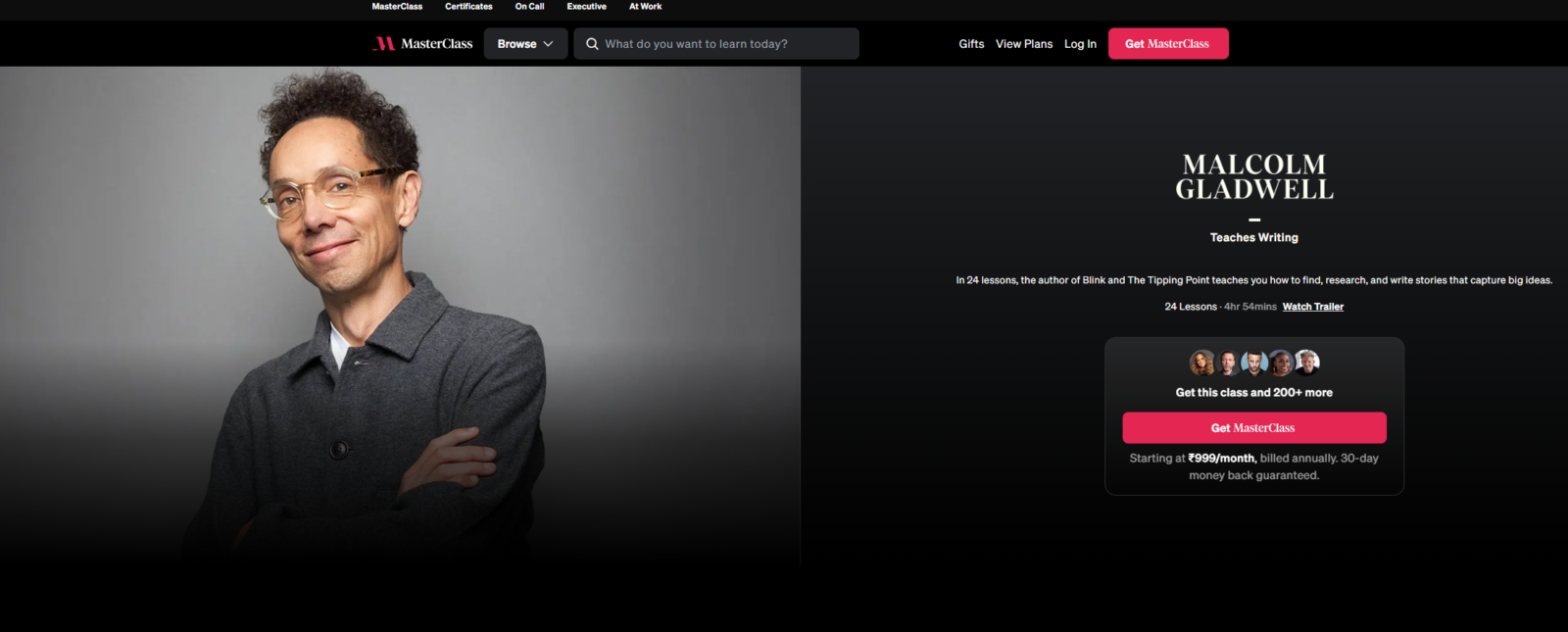
If you run a content-heavy business, write anything professionally, or just want to understand how the most compelling nonfiction in the world actually gets built, this class is essential. Malcolm Gladwell is the author of The Tipping Point, Blink, Outliers, and Talking to Strangers. He is one of the most widely-read nonfiction writers of the last 25 years, and he is a genuinely exceptional teacher.
His MasterClass has 24 lessons, which is more than most classes on the platform. He covers how to find a story worth telling, how to use counterintuitive thinking to make familiar ideas feel surprising, how to write an opening line that pulls the reader forward, and how to think about the reader as a participant in the story rather than a passive consumer. The session on how he does his research and the session on how he decides what to leave out of a piece are the two I have rewatched most.
What I took away from this class that changed my actual work: I stopped starting articles with what the article is about. I started starting articles with a story, a moment, or an observation that creates a question in the reader’s mind. My engagement metrics went up. That is not a coincidence.
The workbook is excellent. Gladwell writes assignment prompts for each lesson that push you to actually practise the concepts rather than just absorb them passively.
Who it is for: Bloggers, content marketers, journalists, authors, or anyone who communicates through writing professionally.
3. Daniel Pink Teaches Sales and Persuasion
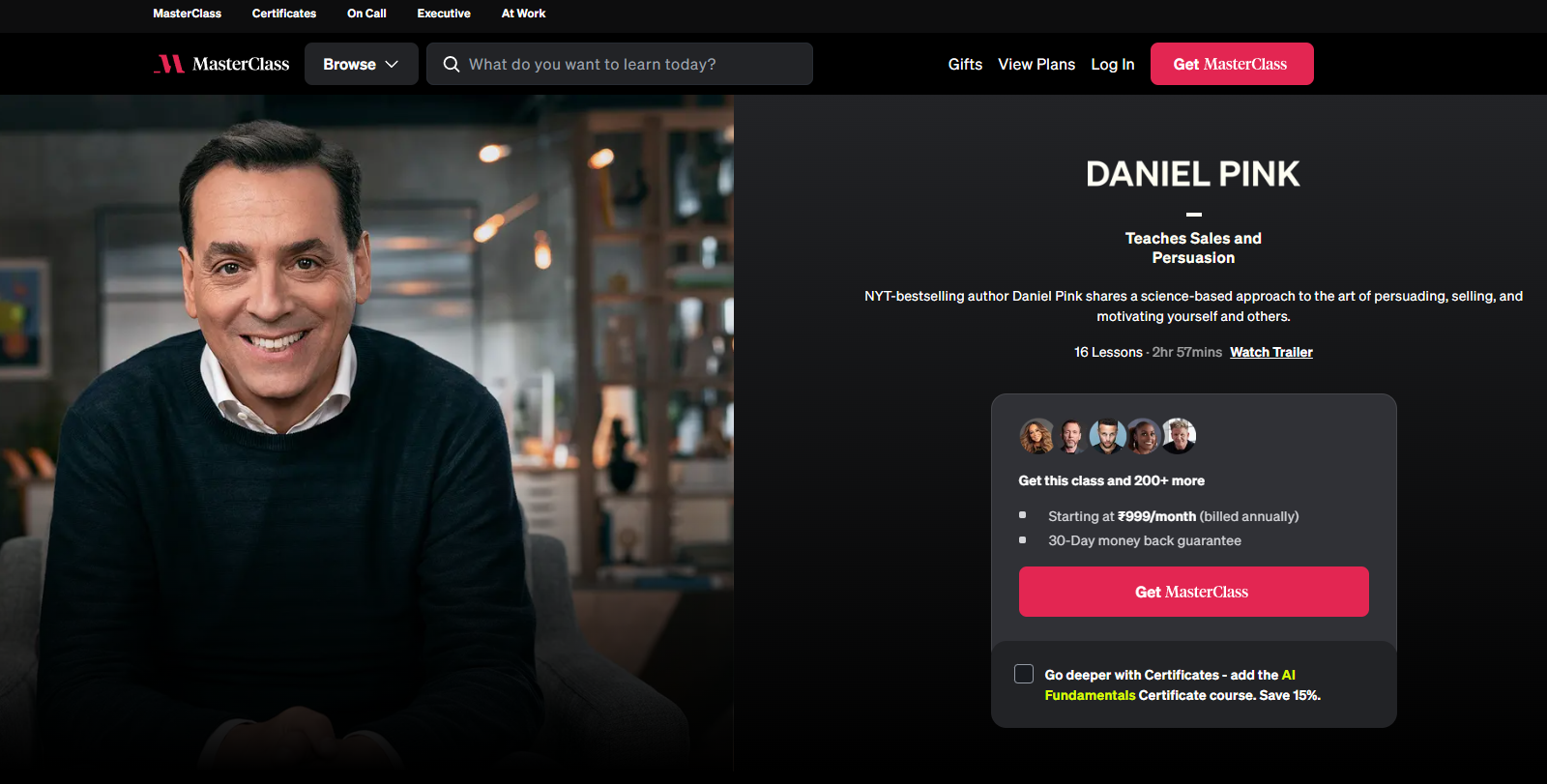
Daniel Pink wrote To Sell Is Human and Drive, two of the most data-driven books on persuasion and human motivation available. His MasterClass translates those books into a practical course on how to move people, meaning how to get them to take action, change their mind, or say yes.
The class covers attunement, which is the ability to read a situation and position from the other person’s perspective. It covers buoyancy, which is how to stay resilient in the face of rejection. It covers clarity, which is the skill of framing problems in a way that makes the solution obvious. There are sessions specifically on pitching, on asking the right questions, and on how to serve rather than sell.
For affiliate marketing, this class is the most directly applicable one on the entire platform. Understanding why people click, why people buy, and how to frame an offer in terms of what the reader loses by not acting rather than what they gain by acting, that is the core of conversion writing. Pink explains the psychology behind all of it with rigorous research and clear examples.
I went back through three of my top converting review articles after watching this class and rewrote the sections around call to action. The framing changed. The results changed.
Who it is for: Marketers, affiliate writers, salespeople, entrepreneurs, and anyone who creates content designed to drive action.
4. Gordon Ramsay Teaches Cooking I and II
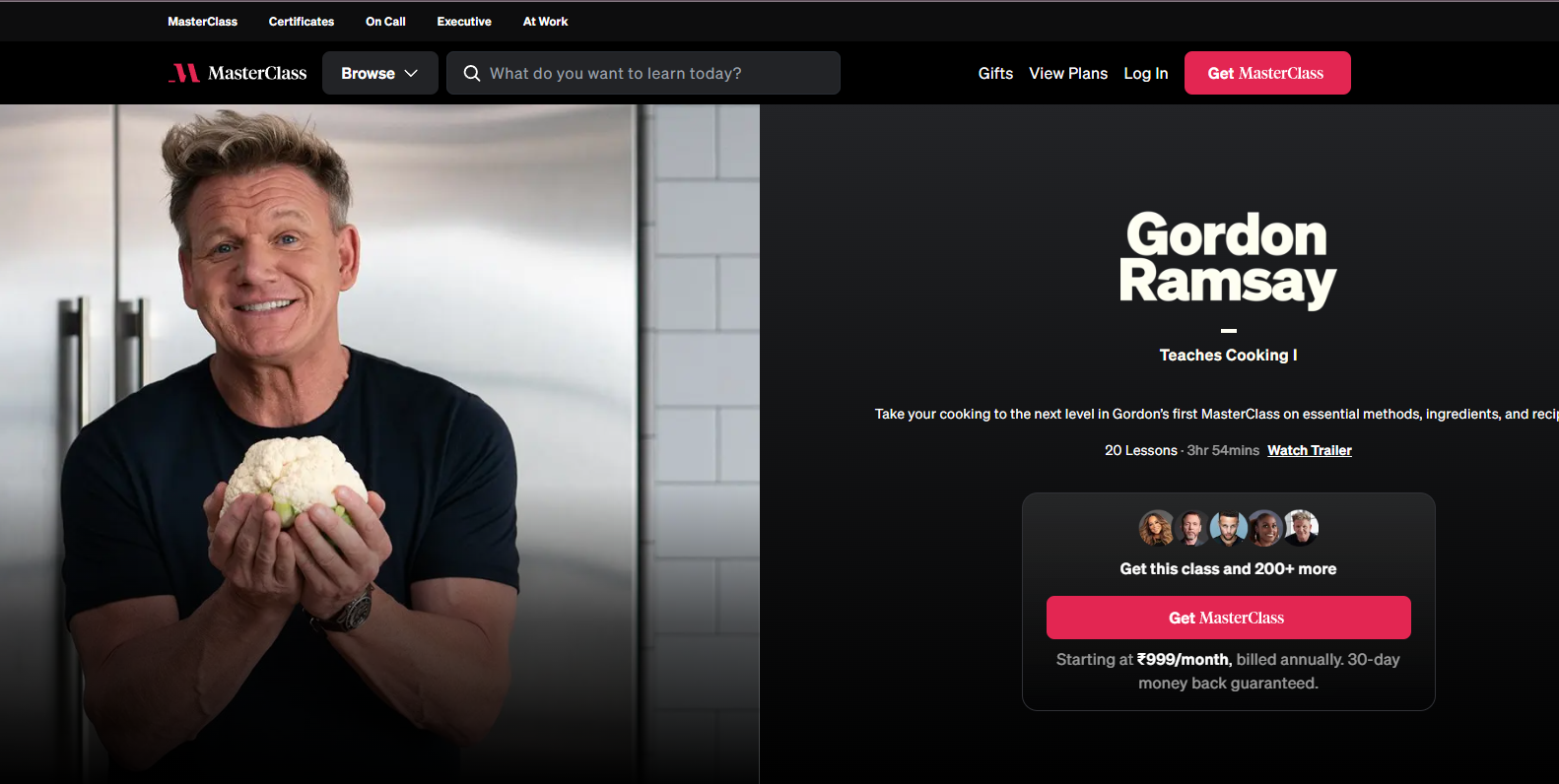
This is the most fun I have had on MasterClass. Gordon Ramsay has two cooking classes on the platform. The first covers fundamentals including knife skills, stocks, sauces, eggs, pasta, and vegetables. The second goes deeper into advanced techniques including seafood, meat, and global cuisines.
Ramsay is exactly who you expect him to be on camera, intense, precise, and completely uncompromising about technique. But he is also surprisingly patient and generous as a teacher. He explains the why behind every technique, not just the what. Understanding why you rest meat after cooking it, why you season pasta water, why you hold a knife a certain way, makes the skills stick in a way that recipe following never does.
The production quality in this class is the best on the platform. Every shot of food looks extraordinary. The lighting and camera work in the cooking sequences are genuinely cinematic. It feels like watching a premium cooking show, except every lesson is teaching you something you can replicate at home that evening.
I cooked the scrambled eggs lesson on a Saturday morning and have never made eggs the same way since. That is the measure of a good class. It changes your daily behaviour.
Who it is for: Anyone who wants to cook better. Absolute beginners and experienced home cooks both get a lot from this.
5. Aaron Sorkin Teaches Screenwriting
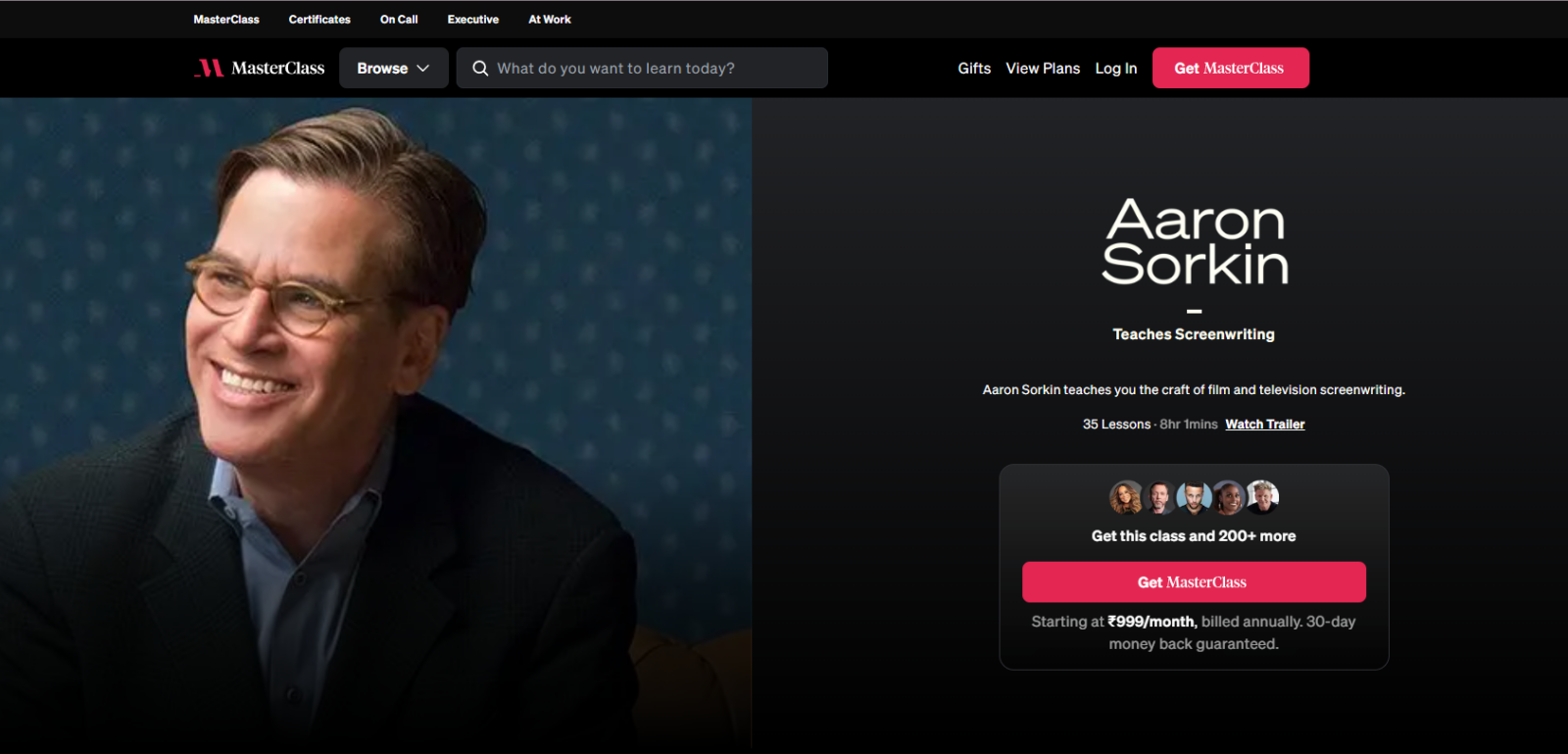
Aaron Sorkin wrote The Social Network, A Few Good Men, The West Wing, Steve Jobs, and Moneyball. He is arguably the best dialogue writer working in Hollywood today. His MasterClass covers story structure, character, conflict, dialogue, and the moral stakes that make drama worth watching.
The class is 35 lessons, which makes it one of the longest on the platform. Sorkin is thoughtful, reflective, and honest about his process in a way that feels rare for someone at his level. He admits his limitations openly. He talks about the times he got it wrong. That honesty makes everything he says more credible.
Even if you have no interest in screenwriting specifically, this class teaches you something that applies to all forms of writing and communication. Sorkin’s framework for stakes, that every scene needs to be about something the character wants and something standing in the way of getting it, is a structure I now apply to product reviews, emails, and pitches. The tension framework works in any medium.
The session on dialogue is worth the entire MasterClass subscription on its own. Sorkin’s explanation of how characters talk past each other while actually revealing everything about who they are is something I have not seen explained better anywhere else.
Who it is for: Writers, content creators, marketers who want to understand narrative structure, and anyone who tells stories for a living.
6. Sara Blakely Teaches Self-Made Entrepreneurship
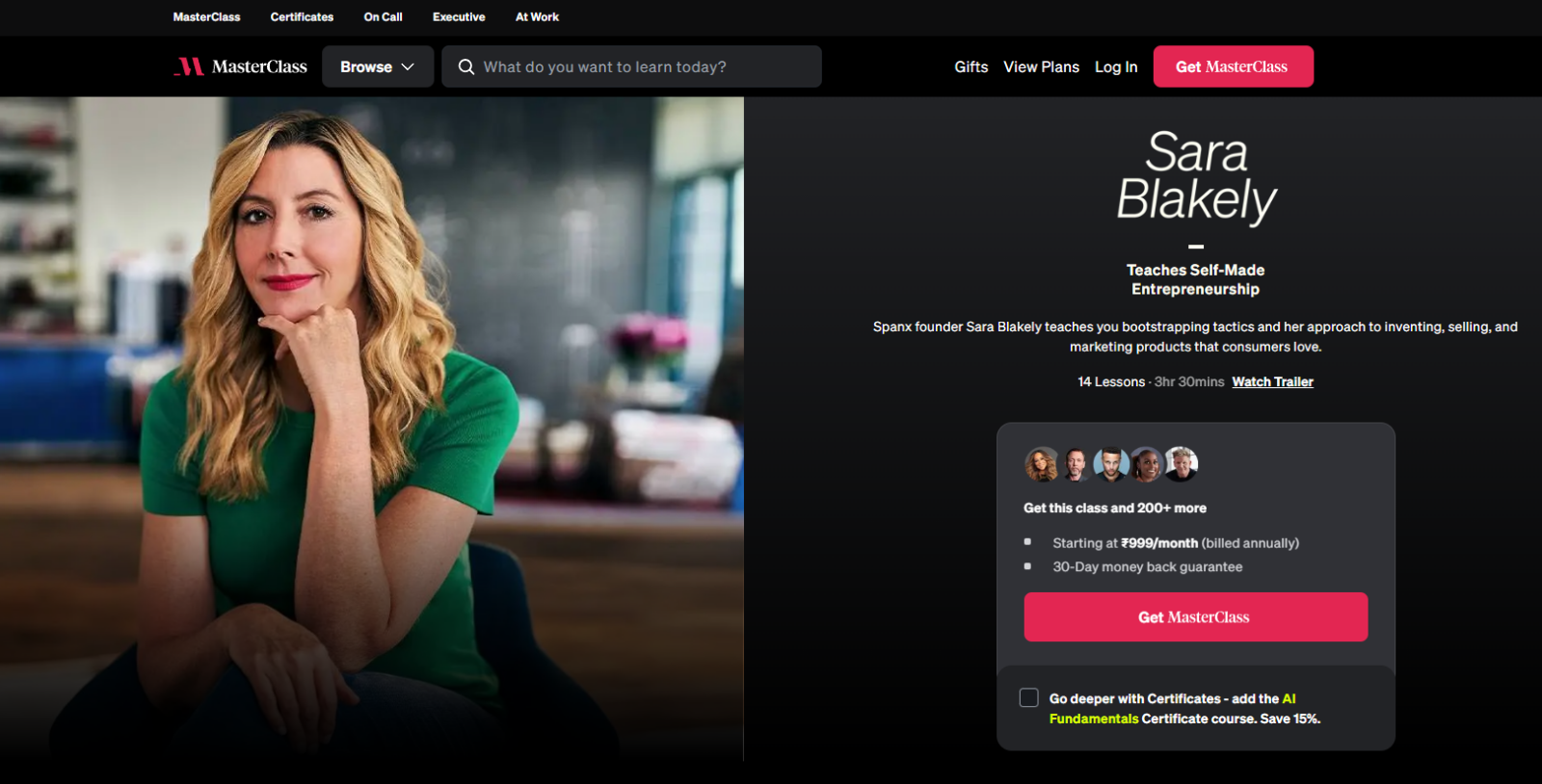
Sara Blakely built Spanx from a $5,000 savings account into a billion-dollar brand without outside investment and without a business background. Her MasterClass is one of the most honest business courses I have watched on any platform, ever.
She talks about getting rejected by every hosiery manufacturer she approached. She talks about how she wrote her own patent application because she could not afford a lawyer. She talks about how she got her first retail placement and what she said in that meeting. She talks about how she thinks about failure as data rather than defeat.
For affiliate marketers and online entrepreneurs, the value here is not tactical. It is foundational. Blakely’s class reframes what it means to start with nothing and build something. Her lesson on the power of the untrained eye, meaning that not knowing the rules of an industry can be an advantage rather than a weakness, is one of the more liberating ideas I have taken from any course anywhere.
She is also an exceptional communicator. The class is warm, personal, and energetic in a way that keeps you engaged across every lesson.
Who it is for: Entrepreneurs, freelancers, solo business builders, and anyone who is building something without permission or resources.
7. Neil Gaiman Teaches the Art of Storytelling
Neil Gaiman wrote American Gods, Good Omens, Coraline, The Sandman, and Neverwhere. He is one of the most versatile and widely loved storytellers of his generation, and his MasterClass feels like being let into his imagination for a few hours.
The class covers where ideas come from, how to find your voice, how to build worlds, how to write characters that feel alive, how to use myth and archetype without being derivative, and how to finish things. That last topic, on finishing, is something a lot of creative people genuinely struggle with and Gaiman addresses it directly and practically.
What makes this class exceptional is how personal it is. Gaiman shares his actual fears about writing, his actual doubts, and the actual moments where he was not sure if what he was making was any good. That vulnerability from someone at his level of success is genuinely reassuring and instructive for anyone who creates anything.
The session on using your own life as raw material without cannibalising it is one of the most useful things I have watched on the platform.
Who it is for: Fiction writers, bloggers, content creators, and anyone who wants to tell better stories in any medium.
8. Matthew Walker Teaches the Science of Better Sleep
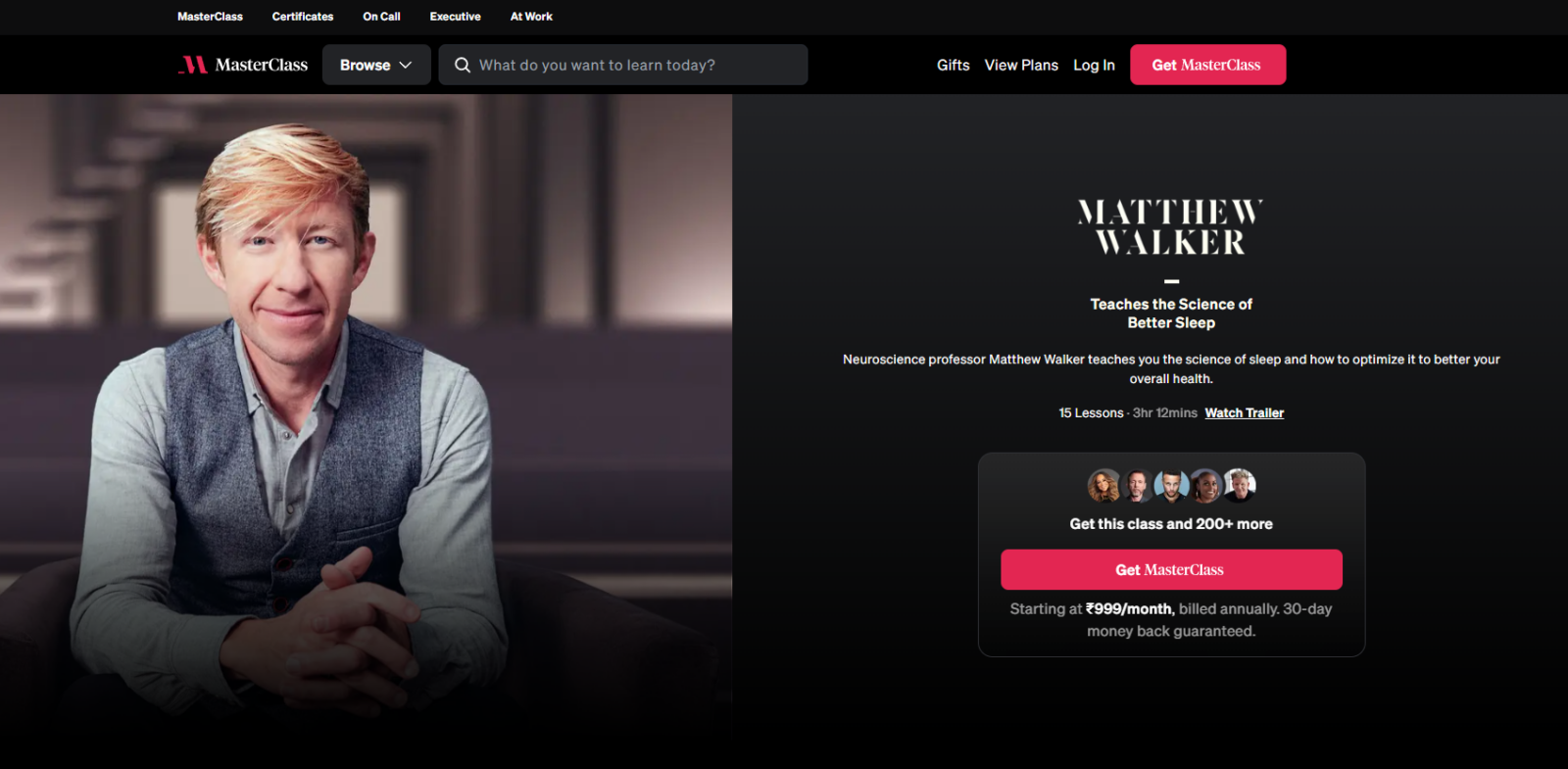
This one surprised me. I did not expect a sleep science course to be one of the most impactful things I have watched on MasterClass. Matthew Walker is a neuroscience professor at UC Berkeley and the author of Why We Sleep, one of the most widely read science books of the last decade.
His class is 15 lessons running around three hours total. He covers what actually happens in the brain and body during sleep, why sleep deprivation is catastrophically more damaging than most people realise, what destroys sleep quality including alcohol, temperature, caffeine timing, and screen light, and what genuinely improves it.
I changed my sleep schedule, my room temperature, and my caffeine cutoff time after watching this class. Within two weeks I noticed a measurable difference in my energy and focus during working hours. That is direct, practical, life-changing information delivered by one of the world’s leading experts.
Walker is also one of the best communicators on the platform. He is not a celebrity instructor. He is a scientist who happens to be extraordinarily good at explaining complex research in plain language without dumbing it down.
Reddit reviewers consistently call this the best MasterClass on the platform, and based on the practical impact it has had on my daily performance, I understand why.
Who it is for: Everyone. Seriously, everyone.
9. Bob Iger Teaches Business Strategy and Leadership
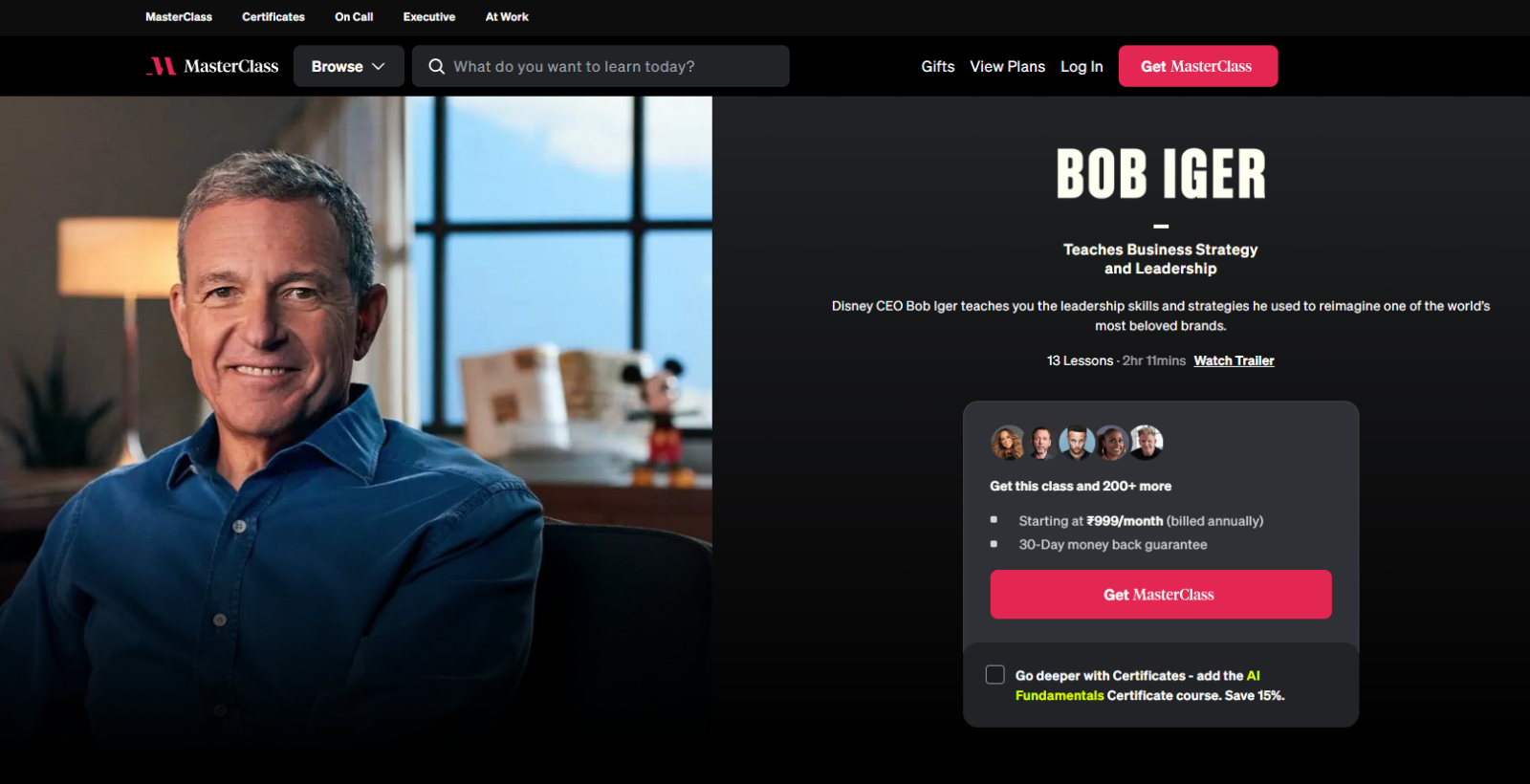
Bob Iger ran Disney for 15 years and oversaw the acquisitions of Pixar, Marvel, Lucasfilm, and 21st Century Fox. He turned Disney from a struggling legacy brand into arguably the most dominant media company on earth. His MasterClass covers how he thinks about strategy, risk, acquisition, culture, and leadership.
This class is slower and more reflective than some of the others on this list. Iger is not a high-energy performer. He speaks carefully and precisely. But the quality of insight per sentence is higher than almost any other business class on the platform.
His framework for evaluating big decisions, specifically how he thinks about reversible versus irreversible choices and how he approaches uncertainty with optimism as a discipline rather than a mood, has changed how I approach decisions in my own business. The session on how he handled the Pixar acquisition and what he learned from walking into Steve Jobs’s office with a bold idea is worth watching multiple times.
Who it is for: Entrepreneurs, business owners, senior professionals, and anyone who makes strategic decisions under uncertainty.
10. Timbaland Teaches Producing and Beatmaking
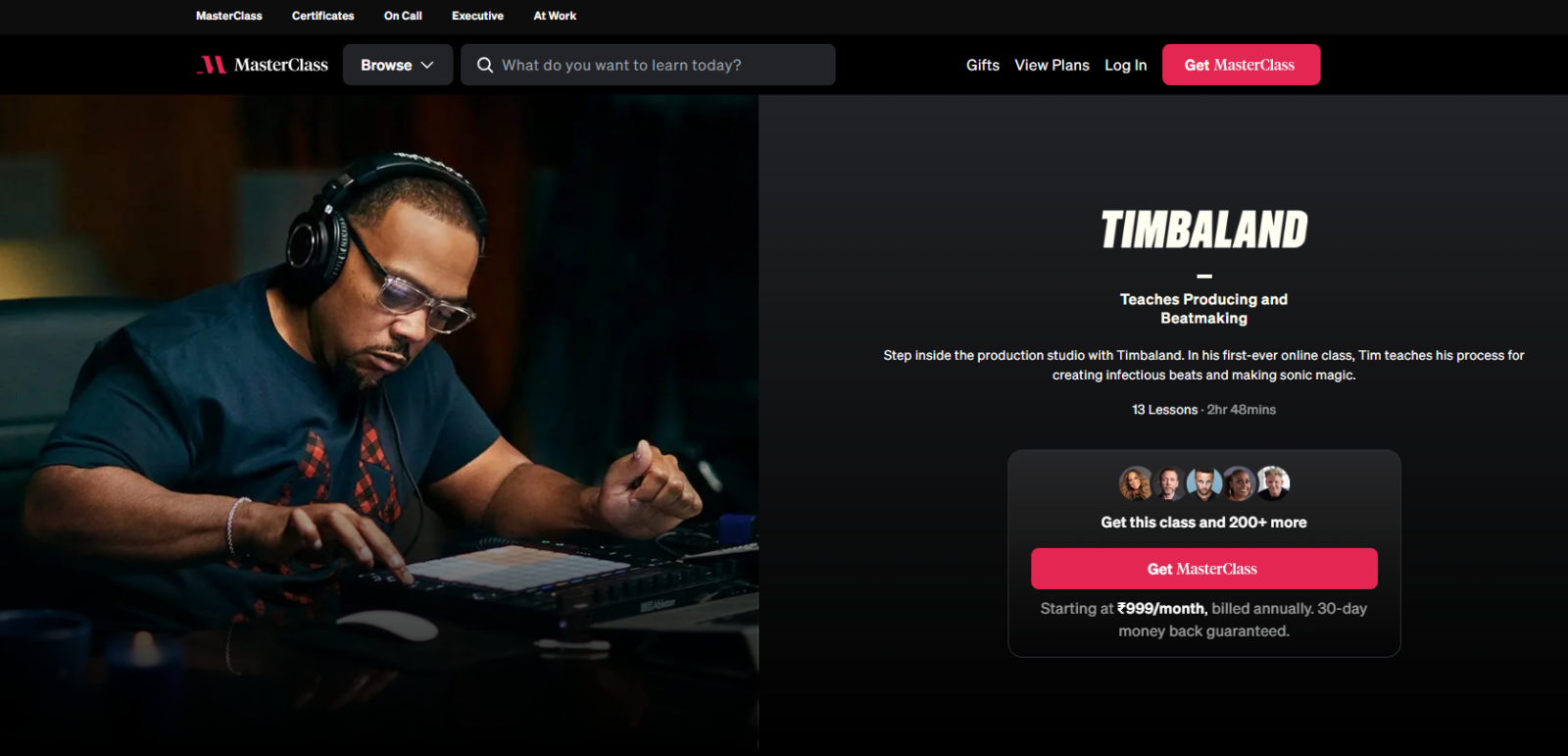
If you are a musician, a producer, or someone who creates content that involves audio, this class is exceptional. Timbaland has produced some of the most commercially successful and sonically innovative music of the last 25 years, including work with Jay-Z, Beyonce, Justin Timberlake, and Missy Elliott.
His class is roughly three hours across 15 lessons and covers how he builds a beat from scratch, how he thinks about sonic texture, how he chops samples, and how he approaches melody and rhythm as a single unified idea rather than separate elements. He works live in his DAW throughout the class, which makes the technical content immediately translatable.
The community response to this class among music producers is consistently enthusiastic. Beginners find it inspiring without being overwhelming. Intermediate producers find specific technical insights that shift how they approach their own work.
Who it is for: Music producers, beatmakers, musicians, and content creators who score or produce their own audio.
What’s New at MasterClass in 2026: Certificates Are Coming
This is the development that most reviews are missing and it is genuinely significant.
MasterClass is launching a Certificates program in Fall 2026. These are not the simple completion badges that the platform has always offered. The new Certificates are 15 to 20 hour project-based courses built in partnership with major companies. Two that are confirmed for Fall 2026 include a Decision Intelligence Certificate and a Growth Strategy Certificate built with Uber, which covers how to spot growth opportunities, test new ideas, and scale what works using lessons directly from Uber’s own growth team.
This is a significant shift in what MasterClass offers. It moves the platform from pure inspiration-based content toward something closer to career-applicable credentials. Whether these certificates will carry the same weight as Google Career Certificates from Coursera remains to be seen, but the direction is clear. MasterClass is trying to compete more directly for the career development audience, not just the lifelong learner audience.
If you are evaluating MasterClass right now, the Certificate program is worth factoring into your decision, especially if you work in strategy, business, or marketing roles where applied project-based credentials add visible value.
The Courses I Would Skip
Not every class on MasterClass is worth your time. In the interest of honesty, here are the ones I found disappointing relative to the hype.
The Annie Leibovitz Photography class is the most commonly cited letdown on the platform, and I agree with that assessment. Leibovitz is a living legend but the class is more of a philosophical musing on photography than an actual teaching experience. If you want to get better at photography as a technical skill, this class will leave you wanting. If you want to understand how one of the greatest portrait photographers in history thinks about her subjects, it has some value.
The Serena Williams Tennis class is beautifully produced and genuinely inspiring, but at just 10 lessons and under two hours of content, it is the shortest class on the platform. The technique content is solid for beginners but intermediate and advanced players will find it thin.
Howard Schultz’s Business Leadership class has excellent moments but some reviewers, and I agree with this, find that Schultz stays at such a high level of abstraction that specific actionable lessons are hard to pin down. It is inspirational in the way that a well-delivered keynote speech is inspirational. Less useful as a practical business course.
Final Thought: Which Courses to Start With
If you are new to MasterClass and want to get the most value immediately, start with the course that is most directly relevant to what you do professionally, then branch into something completely outside your world. The combination of focused professional value and unexpected creative stimulation is what makes the subscription worth maintaining long-term.
For anyone in affiliate marketing, content creation, or digital business, my recommended starting sequence is Daniel Pink first for the direct marketing application, then Malcolm Gladwell for writing, then Chris Voss for negotiation. After those three you will have a clearer sense of whether MasterClass fits how you learn and whether you want to go deeper into the library.
The Standard plan at $120 per year and a 30-day money-back guarantee means the risk of trying it is genuinely low. Three courses in 30 days is enough to know whether this platform works for you.
FAQs
Based on production quality, actionable content, and rewatch value, Chris Voss Teaches the Art of Negotiation ranks as the strongest overall course. It combines practical frameworks you can use immediately with genuinely engaging teaching, which is rare on the platform.
Start with one or two courses in a category you already care about rather than jumping around. Finishing one class fully, workbook included, teaches you more than sampling five classes halfway.
No, because the pricing is subscription-based rather than per-course, so a single class costs the same as full-year access to over 200 classes. If you only want one course, use a Guest Pass first to confirm it delivers before paying.
Yes, ranking by category is more useful since comparing a cooking class to a negotiation class is subjective. Within writing, business, and creativity categories specifically, certain instructors consistently outperform others in clarity and depth.
Fame does not guarantee teaching ability, and some celebrity instructors lean heavily on storytelling and personal anecdotes rather than transferable frameworks. The courses ranked highest are the ones with clear, repeatable takeaways you can apply the same day.
