
Vimmy review in short: Vimmy is a self-serve push and popunder ad network from the Netherlands that works for both advertisers buying traffic and publishers monetizing it. It suits affiliates who run push, in-page push, iOS calendar push or popunder campaigns on a small test budget, and publishers who want an 85% revenue share with weekly payouts from $50. It is not a premium display network, and its marketing claims are bigger than the proof it publishes. I checked every figure below against Vimmy’s own website on 29 October 2026.
Below I cover what Vimmy is, what it costs to advertise, what publishers earn, the ad formats and targeting, how to sign up, the pros and cons, and my final verdict.
Content Outline
What Is Vimmy?
Vimmy is an AdTech company run by Vimmy B.V., registered at Beechavenue 54 in Schiphol-Rijk, Netherlands. Its about page says it was founded in 2018 by a team with more than ten years of experience in traffic acquisition and performance marketing. It connects advertisers who want cheap, high-volume traffic with publishers who want to sell their visitors’ attention.
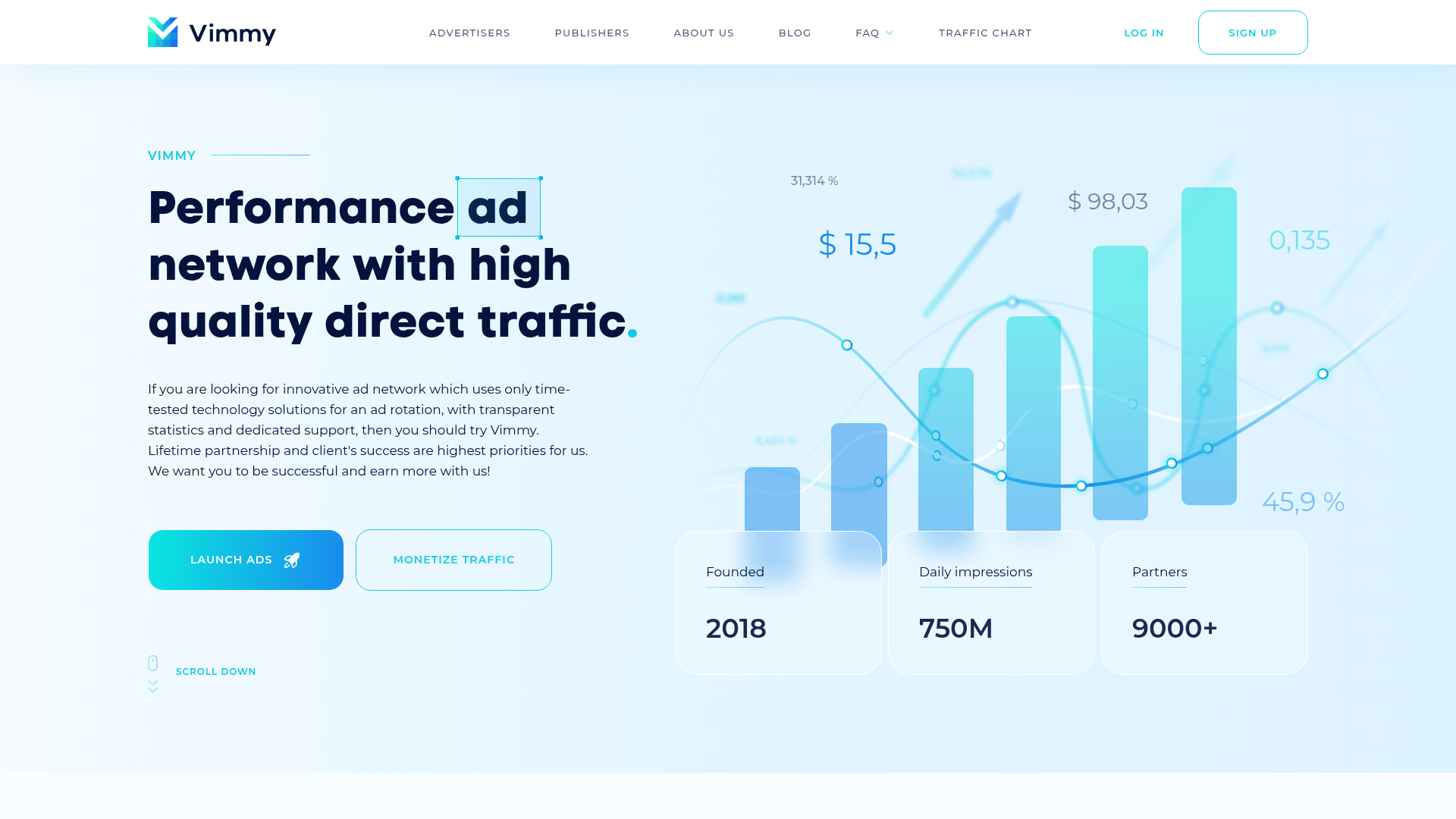
The headline numbers depend on which page you read. The homepage claims 750 million daily impressions and 9,000+ partners, while the about page lists 600 million+ daily impressions, 5,000+ publishers, 3,000+ advertisers and 25,000+ conversions per day. Treat both as Vimmy’s own marketing figures rather than audited stats; they at least agree that this is a mid-sized network, not a giant like the biggest push platforms.
One thing I noticed: the newest posts in Vimmy’s advertiser blog are from October 2024, and the publisher blog stops in mid-2023. The platform, sign-up and FAQ pages are all live, but the slow blog suggests a small team, so test with a small deposit before you scale.
Vimmy Pricing for Advertisers
Vimmy has no plans or subscriptions. You fund your balance and pay for traffic as you use it. According to the advertiser FAQ, push, in-page push and iOS calendar push are sold on a CPC (cost per click) basis, and popunder is sold on a CPM (cost per thousand impressions) basis. Prices checked on 29 October 2026.
| Item | What Vimmy says |
|---|---|
| Minimum deposit (cards, Paxum, Payoneer, WebMoney) | $100 |
| Minimum deposit (wire transfer) | $500 |
| Minimum bid | $0.001 per click |
| Buying model | CPC for push, in-page push and calendar push; CPM for popunder |
| Deposit methods | Visa, Mastercard, wire transfer, Paxum, Payoneer, WebMoney |
| Promo codes | Entered in the Promo Code field under Add Funds (no public code listed) |
| Refunds | Requested through support live chat |
| Stats time zone | UTC+3 by default, changeable in Statistics |
The minimum bid of $0.001 is a floor, not a realistic price. Vimmy publishes a public traffic chart with recommended bids by country and format, and that is where you should look before you set a CPC. One cost that surprises new buyers: push clicks can arrive after you pause a campaign, because notifications already sent can still be opened, and those late clicks are charged to your balance.
Note that the old version of this review said the minimum deposit was $50. Vimmy’s FAQ now says $100 for most methods and $500 by wire, so budget for that.
Vimmy for Publishers: Revshare and Payouts
On the publisher side, Vimmy pays an 85% revenue share, which it calls the highest on the market. It also claims eCPM of up to $150 with its smart optimization, but that is a best case, not an average; the publisher FAQ itself warns that revshare income builds up gradually.
| Publisher term | What Vimmy says |
|---|---|
| Revenue share | 85% |
| Minimum payout | $50 |
| Payout frequency | Weekly |
| Payout methods | WebMoney, Payoneer, PayPal, Paxum, wire |
| Integration | One MultiTag for all ad formats, about 5 minutes to set up |
| Adult sites | Accepted |
| Ad filtering | Available on request through support |
Setup is three steps: create an account, put the MultiTag on your site, and start earning. One tag serves every ad format, so you do not need a separate code for push, in-page push and popunder. Two FAQ points are worth knowing before you join: Vimmy suspends accounts and rejects payouts when it finds bot traffic, and if you change your domain you have to verify the site and install the codes again. Push revenue also only counts visitors who subscribe to your notifications, so impressions will look low next to your total visitor count.
Vimmy Ad Formats
Vimmy sells four formats. Here is how each one works, based on the descriptions on Vimmy’s advertiser and publisher pages:
- Push notifications: classic browser push sent to users who opted in. Vimmy pitches it as its main format, with large volume and high CTR on desktop and mobile.
- In-page push: looks like a push message but appears inside the website the user is on, so it needs no opt-in and works on every OS and browser, including iOS.
- Calendar push: ads delivered as events in the calendar app of iPhone and Mac users who subscribed. It is Vimmy’s way to reach iOS and macOS traffic, which classic push cannot.
- Popunder: a full page opened in a new window or tab behind the main browser. It is the cheapest format and gives the most volume, sold on CPM.
Vimmy says the verticals that work best are gambling, subscriptions, VPN, sweepstakes, dating, gaming, software and utilities, finance and eCommerce. That list tells you the traffic is aimed at affiliate and performance offers, not brand campaigns.
Targeting, Tracking and Optimization Tools
For a self-serve network, the targeting is solid. The advertiser FAQ lists these options:
- Country, browser and browser language
- Operating system and version
- Mobile carrier, ISP and connection type (cellular or Wi-Fi)
- IP range and frequency capping
- Age of subscription (push only)
- Site and placement blacklists and whitelists
- Scheduler by day of week and time
Conversion tracking runs through S2S (server-to-server) postbacks, with templates for the popular trackers in the Tracking tab. The Smart Optimisation Tools can pause creatives whose CTR falls below your threshold, pause creatives whose CPA goes above your goal, and blacklist placements that miss your CPA target. API access is available, but you have to ask support for a token. Vimmy says campaigns get traffic instantly after approval because moderation is done by AI, and that every ad and URL is checked for malware before approval.
How to Start With Vimmy
- Go to vimmy.com and click Sign up.
- Choose whether you are a publisher (monetize traffic) or an advertiser (promote a CPA offer), then enter your email, password and a messenger contact such as Telegram.
- Confirm the registration link Vimmy emails you.
- Advertisers: add at least $100 under Add Funds, check the traffic chart for bids, and launch a small test campaign with S2S tracking set up.
- Publishers: verify your site, install the MultiTag, and add a payout method so you can withdraw once you reach $50.
Vimmy Pros and Cons
Pros
- Four formats in one account, including calendar push for iOS and Mac traffic
- Low entry point for testing at $100, with bids from $0.001
- Useful automation that pauses weak creatives and blacklists bad placements
- 85% revshare and weekly publisher payouts from $50, with PayPal among the options
- Detailed targeting, S2S tracking and API access
- 24/7 support and a dedicated account manager for advertisers, according to Vimmy
Cons
- Only push and popunder style formats, no native, banner or video
- Marketing figures differ between pages and are not independently verified
- Late push clicks after pausing are still charged
- Wire deposits need at least $500
- The blog has been quiet since 2024, so the company looks small
Vimmy Alternatives Worth Checking
If you are comparing push traffic sources, my list of the best push notification ad networks covers the main options side by side. For specific rivals, read my Push.House review for another push-focused network, my Zeropark review if you also want domain redirect traffic, and my Monetag review if you are a publisher looking for another popunder and push monetization option.
Vimmy Review FAQs
Vimmy is run by Vimmy B.V., a company registered in Schiphol-Rijk in the Netherlands and founded in 2018. It publishes its terms, DSP rules and FAQs, but its traffic figures are its own claims, so start with a small test budget.
The minimum deposit is $100 for cards, Paxum, Payoneer and WebMoney, and $500 for a wire transfer. Bids start at $0.001 per click.
Vimmy pays publishers an 85% revenue share. Payouts are weekly once you reach the $50 minimum, through WebMoney, Payoneer, PayPal, Paxum or wire.
Yes. The Vimmy publisher FAQ says adult websites are accepted. Accounts are suspended if Vimmy finds bot traffic.
Yes, through calendar push and in-page push. Calendar push shows ads as events in the calendar app of subscribed iPhone and Mac users, and in-page push needs no opt-in and works on iOS.
Yes, it can. Push notifications already sent may still be clicked after you pause a CPC campaign, and Vimmy charges those late clicks to your balance.
Final Verdict: Is Vimmy Worth It in 2026?
I would use Vimmy as a test traffic source, not a main one. For affiliates running gambling, sweepstakes, VPN, dating or utility offers, the $100 entry point, CPC bids, calendar push for iOS and the auto-optimization rules make it cheap to find out whether its traffic converts for your offer. Set up S2S tracking from day one and watch your placements closely.
For publishers, the 85% revshare, weekly $50 payouts and single MultiTag are fair terms, especially if you run adult or entertainment sites that bigger networks reject. Just do not expect the up-to-$150 eCPM the site advertises; push income grows slowly with your subscriber base.
